

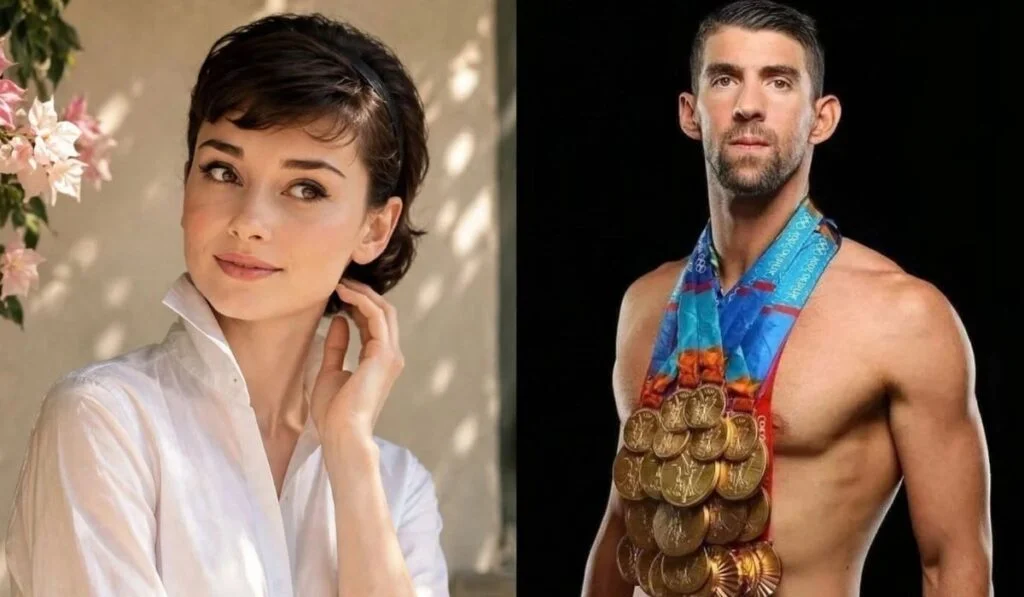
Michael Phelps and Audrey Hepburn may seem like an unlikely pair at first glance. One became famous for dominating the swimming pool and rewriting the record books, while the other became one of Hollywood’s most recognizable actresses and humanitarian figures. Their careers belonged to different generations, their professions were completely different, and their public images developed in very different ways. Yet the keyword Michael Phelps and Audrey Hepburn brings together two fascinating examples of people who turned extraordinary talent into lasting cultural influence.
Looking at Michael Phelps and Audrey Hepburn side by side is less about suggesting that they had similar careers and more about understanding what made both figures memorable. Phelps represented athletic excellence, discipline, and competitive determination. Hepburn became associated with elegance, acting talent, fashion, and humanitarian work. Both ultimately became much larger than the professions that first made them famous.
Their stories also demonstrate how the meaning of celebrity can change over time. Phelps became a global sports superstar in an era of 24-hour television, social media, and instant online coverage. Hepburn rose to fame during the golden age of cinema, when movie stars were built through theatrical releases, magazines, television appearances, and carefully managed studio publicity. Despite those differences, both developed legacies that continue to attract attention decades after their most famous achievements.
Who Is Michael Phelps?
Michael Phelps is widely recognized as one of the most accomplished swimmers in Olympic history. Born on June 30, 1985, in Baltimore, Maryland, he began swimming competitively at a young age. His natural ability was matched by an intense commitment to training, which eventually allowed him to compete at the highest level of international swimming.
Phelps made his Olympic debut at the 2000 Sydney Games when he was only 15 years old. Although he did not win a medal at those Games, his appearance was an early indication that he was destined for a remarkable career. Four years later, at the Athens Olympics, he emerged as a major international star by winning six gold medals and two bronze medals.
His success continued through multiple Olympic Games. At the 2008 Beijing Olympics, Phelps won eight gold medals, setting a remarkable benchmark in Olympic competition. He later added more medals at the 2012 London and 2016 Rio de Janeiro Games. By the end of his Olympic career, he had collected 28 medals, including 23 gold medals.
Who Was Audrey Hepburn?
Audrey Hepburn was a British actress and humanitarian whose influence extended far beyond the movie industry. Born on May 4, 1929, in Brussels, Belgium, Hepburn spent part of her childhood in the Netherlands during World War II. Her experiences during the war became an important part of her personal history and later influenced her humanitarian interests.
Hepburn’s breakthrough came in the early 1950s. Her performance in Roman Holiday earned her the Academy Award for Best Actress and established her as a major Hollywood star. She quickly became known for her distinctive screen presence, graceful style, and ability to combine sophistication with warmth and humor.
Her film career included memorable productions such as Sabrina, Funny Face, Breakfast at Tiffany’s, Charade, and My Fair Lady. Although she became strongly associated with glamorous fashion and classic cinema, Hepburn’s legacy eventually expanded into humanitarian work. She served as a UNICEF Goodwill Ambassador and devoted significant attention to children affected by poverty, hunger, and humanitarian crises.
Michael Phelps and Audrey Hepburn Represent Different Forms of Excellence
The most interesting aspect of Michael Phelps and Audrey Hepburn is the contrast between their fields. Phelps achieved greatness through physical performance, while Hepburn built her reputation through acting and artistic expression. Their achievements required completely different skill sets, but both depended on preparation, consistency, and the ability to perform under enormous public pressure.
Elite swimming requires repetitive training, technical precision, physical conditioning, and extraordinary mental focus. Phelps spent years developing his technique and conditioning his body for competitions that could be decided by fractions of a second. His success was therefore not simply the result of natural talent. It reflected an unusually demanding level of preparation.
Hepburn’s profession required another kind of discipline. Acting demanded emotional control, memorization, timing, collaboration, and the ability to communicate with audiences through subtle expressions and gestures. Her performances often appeared effortless on screen, but that ease was supported by extensive preparation and professional experience.
Their Relationship With Fame
Fame affected Phelps and Hepburn in very different historical environments. Phelps competed during a period when athletes could become global celebrities almost overnight. Major competitions were broadcast internationally, while online platforms allowed fans to follow athletes beyond sporting events. His Olympic achievements consequently became part of a much larger media ecosystem.
Hepburn experienced fame during a period when Hollywood stars occupied a particularly influential place in popular culture. Movie premieres, fashion photography, newspapers, magazines, and television helped establish her public identity. Her image became closely connected with classic Hollywood elegance, and her appearance influenced fashion trends for generations.
Interestingly, neither person’s legacy depends entirely on their original profession. Phelps is remembered not only as a swimmer but also as a symbol of Olympic achievement. Hepburn is remembered not only as an actress but also as a fashion icon and humanitarian. Their fame evolved because audiences continued finding meaning in their stories long after individual performances or films had ended.
The Importance of Discipline in Both Stories
Discipline is another useful connection when discussing Michael Phelps and Audrey Hepburn. Phelps’s career provides an obvious example. Competitive swimming at the Olympic level requires years of structured training, recovery, technical work, and competition preparation. Maintaining that standard over several Olympic cycles is particularly difficult.
Hepburn’s career also required substantial discipline, although it looked very different. She worked in demanding film productions, learned choreography and dialogue, and adapted to different directors and acting partners. Her performances in musicals, romantic comedies, dramas, and other genres demonstrated versatility rather than relying on a single screen persona.
Both stories show why extraordinary results rarely come from talent alone. Talent can create an opportunity, but sustained success usually depends on preparation and consistency. Phelps and Hepburn reached different kinds of audiences, yet both demonstrated the value of developing a craft over time.
Audrey Hepburn’s Humanitarian Legacy
One of the most important parts of Hepburn’s story is her work with UNICEF. After achieving extraordinary success as an actress, she dedicated substantial time and public attention to humanitarian causes. Her experiences as a child during World War II gave her a personal understanding of hunger and hardship, although her humanitarian work later reached communities facing different challenges around the world.
As a UNICEF Goodwill Ambassador, Hepburn visited countries where children were affected by poverty, malnutrition, disease, and conflict. She used her international fame to draw attention to issues that might otherwise receive less public visibility.
This aspect of her life is particularly important because it broadened her legacy. Today, discussions about Hepburn frequently include both her cinematic achievements and her humanitarian efforts. Her public identity therefore became associated with service as well as entertainment.
Michael Phelps Beyond the Swimming Pool
Phelps’s post-competition identity has similarly involved more than medals. After becoming one of the most decorated Olympians in history, he became involved in initiatives related to swimming, youth development, and mental well-being. His public life has included efforts to encourage young people to develop healthier relationships with sport and personal goals.
His foundation has also promoted swimming opportunities and water safety. This is especially meaningful because swimming is not simply an elite competitive activity; learning to swim can be an important life skill. Programs that introduce children to swimming can potentially provide benefits that extend well beyond athletic competition.
Phelps has also spoken publicly about personal struggles and the pressures that can accompany an intensely competitive career. These experiences have contributed another dimension to his public story, showing that extraordinary professional achievement does not necessarily mean a person’s life is free from challenges.
Fashion, Style, and Cultural Influence
Few comparisons involving Michael Phelps and Audrey Hepburn are as visually different as their public images. Phelps became recognizable through athletic uniforms, swimwear, medals, and the highly competitive atmosphere of Olympic sport. His image was closely connected with speed, strength, and sporting achievement.
Hepburn, on the other hand, became one of the defining style figures of twentieth-century cinema. Her collaboration with fashion designers helped establish an aesthetic that remains influential. The little black dress associated with Breakfast at Tiffany’s, for example, became one of the most recognizable fashion images in popular culture.
Hepburn’s style continues to inspire designers, photographers, actors, and fashion enthusiasts. Phelps’s influence is more strongly connected to sports performance and Olympic culture. Both demonstrate, however, how a public figure’s appearance can become part of a much broader cultural identity.
Why People Still Search for Michael Phelps and Audrey Hepburn Together
The phrase Michael Phelps and Audrey Hepburn may attract curiosity precisely because the two names seem so unrelated. Searchers may encounter the names together in social media posts, comparison-style discussions, trivia, visual content, or articles exploring famous personalities from different fields.
There is no widely established professional partnership between Phelps and Hepburn that defines their careers. Their connection is primarily one of cultural comparison. One represents modern Olympic sporting excellence, while the other represents classic cinema, fashion, and humanitarian service.
That distinction matters when researching the two figures. Because internet content can sometimes combine famous names without explaining the actual relationship between them, readers should look for reliable biographical information before assuming that two celebrities shared a significant personal or professional connection.
Lessons From Two Very Different Legacies
The stories of Michael Phelps and Audrey Hepburn offer different lessons about building a lasting legacy. Phelps demonstrates what can happen when an athlete combines extraordinary ability with years of highly focused preparation. His Olympic record remains a central part of modern sporting history.
Hepburn’s story demonstrates how a person’s influence can evolve after professional success. Her films made her famous, but her humanitarian activities became an important part of how she is remembered. Her legacy therefore extends beyond entertainment and into charitable work and global advocacy.
Together, their stories illustrate that fame alone does not determine longevity. Public figures remain culturally relevant when their achievements, personal stories, professional contributions, or charitable work continue to resonate with later generations.
Michael Phelps and Audrey Hepburn: A Lasting Cultural Contrast
Ultimately, Michael Phelps and Audrey Hepburn belong to completely different worlds, but that contrast makes the comparison interesting. Phelps transformed competitive swimming into a showcase of extraordinary Olympic achievement, while Hepburn became a symbol of classic cinema, distinctive fashion, and humanitarian commitment.
Their careers also reflect the eras in which they lived. Hepburn became famous through the traditional Hollywood system of the twentieth century, while Phelps developed into a worldwide sports celebrity during the modern multimedia age. Yet both achieved a level of recognition that extended beyond their original professions.
The enduring interest in Michael Phelps and Audrey Hepburn comes from this unusual combination of differences and similarities. Their talents were different, their careers followed different paths, and their cultural identities developed under very different circumstances. Still, both demonstrated dedication to their crafts and eventually built legacies that continued beyond their most famous professional moments.
For anyone researching these two icons, the most useful approach is to appreciate each story on its own terms. Michael Phelps represents extraordinary athletic accomplishment and Olympic history. Audrey Hepburn represents remarkable cinematic work, enduring style, and humanitarian service. Together, their names provide an intriguing reminder that there are many different ways for an individual to leave a lasting mark on popular culture.
